Why A2A Could Unlock the Next Wave of Enterprise AI Adoption
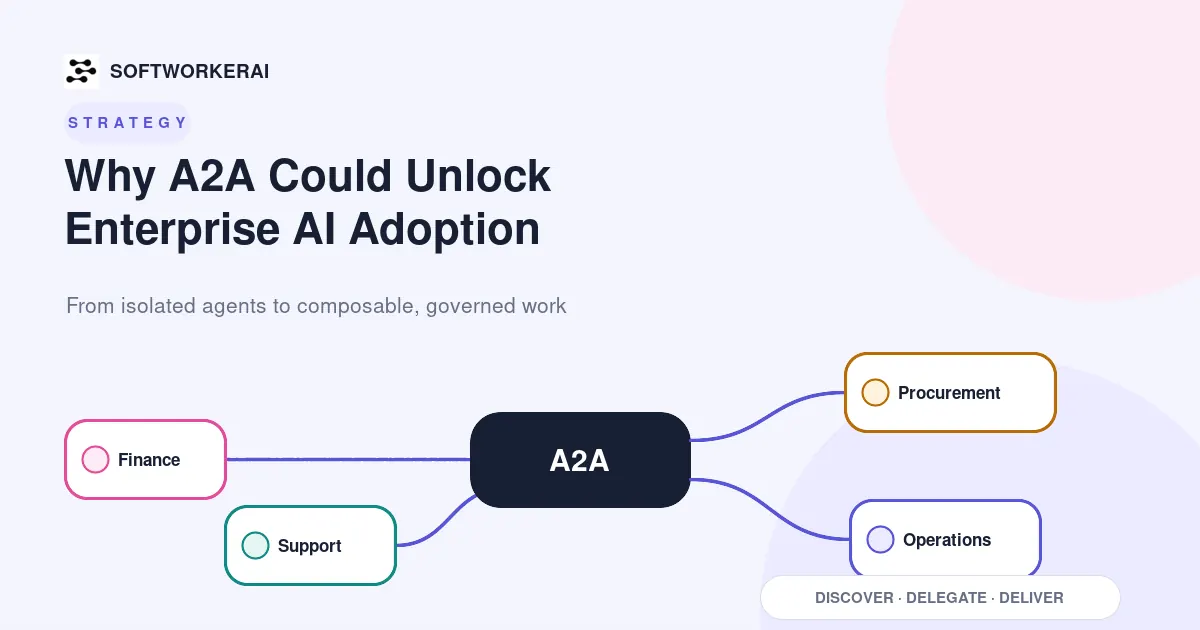
A2A could turn isolated AI agents into a composable enterprise workforce. The value lies in lower integration costs, broader choice, and end-to-end execution.

Key takeaways
- A2A can lower the cost of connecting agents built by different vendors, frameworks, and internal teams.
- Standardized discovery and task handling can make specialized agents easier to find, combine, replace, and reuse.
- The largest value unlock comes from end-to-end workflows that cross application and organizational boundaries.
- Open governance, broad ecosystem support, stable specifications, and familiar web infrastructure can accelerate adoption together.
- A2A enables interoperability, but enterprises still need identity, scoped authority, policy, approvals, audit, and recovery around execution.
The first wave of enterprise generative AI made knowledge easier to reach. The next wave has to make work easier to complete.
That difference is larger than it sounds. Answering a question can happen inside one model and one interface. Completing a business outcome usually requires several systems, specialized capabilities, decisions, handoffs, and accountable people. A customer issue may touch a support platform, billing system, product telemetry, identity service, and communications channel. A supplier renewal may involve procurement, finance, legal, risk, and an executive approver.
No single agent is likely to own all of that. Nor should it.
The more credible future is a network of specialized agents: some built internally, some supplied by software vendors, and some operated by trusted partners. Each understands its own domain. The difficult part is getting them to discover one another, communicate across technical boundaries, coordinate long-running work, and return useful results without exposing their private memory, tools, or implementation.
That is the problem the Agent2Agent Protocol—usually shortened to A2A—is designed to address. A2A is an open standard for communication between independent agent systems. Its specification defines common concepts for capability discovery, messages, tasks, status updates, artifacts, streaming, and asynchronous notifications.
A2A may become a major adoption catalyst not because protocols are exciting in themselves, but because markets accelerate when participants stop rebuilding the same connection layer.
The constraint is shifting from intelligence to interoperability
Models have become capable enough to perform useful specialist work: investigate an alert, assess a contract clause, reconcile an invoice, prepare a case summary, or propose a resolution. Enterprises can already build impressive demonstrations around each of these tasks.
The value often collapses at the boundary between them.
An invoice agent may identify an exception but have no standard way to request a purchase-order check from another agent. A support agent may diagnose an entitlement problem but be unable to delegate the account correction to the agent operated by the billing platform. An internal procurement agent may need supplier-risk analysis from an external provider, yet integrating the two requires a custom contract, custom messages, custom state handling, and custom failure recovery.
This creates an integration tax. Every new agent can add another set of point-to-point connections. The cost grows faster than the number of agents, and the organization becomes reluctant to add, replace, or combine capabilities.
A2A creates a common interaction boundary. According to the A2A v1.0 specification, independent agents can advertise what they do through Agent Cards, exchange structured content, manage stateful tasks, and return artifacts without revealing their internal state, memory, or tools. That is an important separation: agents can collaborate on outcomes while remaining independently built and operated.

A2A standardizes the interaction between agents. A governed execution layer still controls who may delegate, which data may move, and when a person must approve an action.
Seven reasons A2A could accelerate adoption
1. It can reduce the cost of every new connection
Without a shared protocol, connecting two agents is a bespoke integration project. Teams must agree on capability descriptions, message formats, task identifiers, state transitions, result formats, error behavior, authentication, and update delivery.
A2A does not eliminate implementation work, but it can make those decisions repeatable. A client that understands the protocol can interact with many conforming agents. A specialist agent can expose one standard surface rather than maintaining a different adapter for every orchestrator or customer.
The economic effect matters. When the marginal cost of adding an agent falls, more narrowly specialized agents become viable. Organizations can compose capabilities instead of forcing every use case into one general-purpose agent.
2. Discovery can turn agent capability into a reusable resource
Agent Cards allow an agent to publish its identity, endpoint, skills, supported interfaces, and security requirements. This is more than a technical convenience. It creates the foundation for agent catalogs, registries, policy-aware routing, and eventually richer internal or external agent marketplaces.
Today, a team often has to know that a capability exists and then integrate it manually. In a more mature environment, an orchestrator could find approved agents capable of tax validation, shipment tracing, contract analysis, or identity verification and choose among them based on policy, geography, cost, latency, or assurance level.
Discovery makes capabilities easier to reuse. Reuse improves the economics of building a high-quality specialist. Better specialists make the network more valuable. That is the beginning of a reinforcing adoption loop.
3. It supports the shape of real business work
Enterprise tasks are not always quick request-and-response calls. They may run for minutes, hours, or days. They may need clarification, pause for approval, stream partial progress, produce several artifacts, or continue after the initiating user disconnects.
A2A treats a task as a stateful unit of work and supports polling, streaming, and push notifications. Messages can carry text, files, or structured data; completed work can return artifacts. These concepts fit operational workflows better than pretending every collaboration is a single chat turn.
That alignment can unlock use cases previously held back by fragile orchestration. Incident investigation, due diligence, claims processing, hiring, onboarding, procurement, and customer resolution all involve long-running work with intermediate state.
4. It preserves choice and lowers switching risk
Enterprise agent estates will be heterogeneous. Different departments will select different software platforms. Acquisitions will introduce more. Some agents will run in public clouds, others in private environments, and still others inside SaaS products. Internal teams will use different languages and frameworks.
A2A is designed to work across those differences. The protocol supports multiple bindings and version negotiation, while the stable v1.0 release adds features aimed at production environments, including multi-tenancy and signed Agent Cards. The project’s v1.0 announcement also emphasizes compatibility across heterogeneous technology stacks.
An open interaction layer can reduce the fear that choosing one agent platform means committing every future workflow to it. Lower perceived lock-in makes it easier for buyers to start, because today’s investment is less likely to become tomorrow’s migration project.
5. It lets each agent remain a bounded specialist
Interoperability does not require a shared brain.
The protocol is deliberately designed for potentially opaque agents. A remote agent can accept work and return results without handing over its prompt, proprietary logic, private memory, or direct access to its tools. That makes collaboration more practical across vendor and organizational boundaries.
This boundary can also improve system design. A payroll agent should not need to understand the internal reasoning of an identity agent. It needs a dependable interface, an authorized request, a clear result, and evidence appropriate to the task. Encapsulation allows each participant to improve independently while preserving the interaction contract.
The result is not just technical modularity. It creates room for commercial specialization: providers can offer valuable agent capabilities without surrendering their implementation, and enterprises can consume those capabilities without importing an entire platform.
6. It builds on infrastructure enterprises already know
Standards spread faster when they fit existing operational habits. A2A aligns with familiar web architecture and supports bindings such as HTTP with JSON, JSON-RPC, and gRPC. Enterprises can apply many existing patterns for gateways, load balancing, authentication, certificates, network policy, observability, and service management.
This does not make agent communication ordinary. The content and consequences of an agent task still demand stronger governance than a typical API call. But reusing mature infrastructure reduces the amount of entirely new machinery required to operate the network.
The ecosystem signals are also unusually strong for a young protocol. Google introduced A2A in April 2025 with contributions or support from more than 50 technology and services partners. By June 2025, the Linux Foundation launch announcement cited support from more than 100 companies and placed the project under neutral open-source governance. The project now provides SDK work across Python, Go, JavaScript, Java, .NET, and Rust, according to its public roadmap.
Broad backing does not guarantee adoption. It does, however, reduce the coordination problem that often prevents a standard from becoming useful.
7. A2A complements the rest of the agent stack
A2A is sometimes framed as a competitor to the Model Context Protocol, or MCP. That is the wrong mental model.
MCP commonly helps an individual agent connect to tools, data, and context. A2A helps independent agents communicate and coordinate. APIs remain the dependable interfaces to many underlying business systems. An orchestration layer decides how work should be decomposed. A governance layer decides which work is allowed and captures the evidence.
These layers can reinforce one another:
- APIs expose dependable business operations.
- MCP equips an agent with approved tools and context.
- A2A lets agents discover and delegate to other agents.
- Orchestration manages the plan, dependencies, and recovery.
- Governance preserves identity, authority, approvals, policy, and audit.
The combination is more important than any single protocol. It provides a credible path from a useful specialist agent to a controlled, end-to-end business process.
Where the value unlock becomes concrete
Consider employee onboarding.
An HR agent receives an approved hiring record and starts the workflow. It delegates identity creation to an IT agent, equipment selection to a workplace agent, payroll setup to a finance agent, policy acknowledgements to a compliance agent, and initial scheduling to a team operations agent. Some are internal. Others are supplied by the systems that own those functions.
Each specialist can complete its part and return status or artifacts through a common protocol. The HR agent does not need direct credentials to every downstream system. It does not need to absorb payroll, identity, device, or compliance expertise into one enormous prompt. If the organization changes its device-management provider, it can replace one participant without redesigning the entire workflow.
The business value is not “agents talking to agents.” It is a shorter onboarding cycle, fewer missed steps, less manual coordination, clearer ownership, and a complete record of what happened.
The same pattern applies to other cross-boundary outcomes:
- A customer-resolution agent coordinates support, billing, product, logistics, and communications.
- A procurement agent coordinates supplier discovery, risk checks, contract review, budget validation, and approval.
- An incident agent coordinates monitoring, infrastructure, security, change management, and customer communication.
- A revenue agent coordinates CRM research, pricing, legal review, order management, and finance.
- A claims agent coordinates document intake, policy verification, fraud analysis, assessment, and payment approval.
These are attractive use cases because the current cost is often coordination rather than one missing piece of intelligence. A2A targets that coordination layer.
What A2A does not solve
A common protocol makes connection possible. It does not make every connection appropriate.
An Agent Card can describe a capability, but an enterprise still has to decide whether to trust the publisher. Authentication can establish who is calling, but authorization must determine what that caller may ask. A task state can show that work completed, but it does not prove that the work complied with policy or achieved the right business outcome.
Multi-agent systems also create coordination risk. One agent may delegate beyond its authority. Sensitive information may cross a boundary during an otherwise valid task. Several plausible actions may combine into an outcome nobody approved. A compromised or poorly designed specialist can affect the wider network.
Production adoption therefore requires a governed execution environment around the protocol:
- Durable identity for every agent and accountable ownership for its role
- Allowlisted discovery rather than unrestricted access to any advertised agent
- Scoped credentials and least-privilege authority for each delegated task
- Data classification and controls on what may cross agent boundaries
- Approval gates before sensitive, external, expensive, or irreversible actions
- End-to-end traces connecting the original request, delegations, evidence, decisions, and outcome
- Timeouts, budgets, cancellation, revocation, retry rules, and recovery from partial completion
- Evaluation of both individual agent performance and system-level outcomes
This is the distinction between interoperability and trust. A2A can supply a common language. Organizations still need an operating model that decides who may speak, what they may commit to, and how the result is supervised.
How enterprises should approach A2A now
The sensible starting point is not an open-ended mesh of agents. It is one bounded workflow with a measurable coordination problem.
Choose a process that crosses two or three systems, has clear inputs and outcomes, and currently consumes meaningful human effort in handoffs. Define which agent owns the overall result. Allow only explicitly approved agents to participate. Carry task scope and policy constraints with every delegation. Keep consequential actions behind approval gates. Record the complete chain.
Then measure what matters: cycle time, completion rate, handoff delay, exception rate, rework, cost, and the quality of the final outcome. Interoperability is valuable only when it improves the operation.
As evidence accumulates, add specialists, widen low-risk authority, and test portability by replacing one agent implementation without changing the whole workflow. That exercise will reveal whether the organization has adopted a standard interface or merely moved its coupling into a new layer.
The protocol is not the product—the network is
A2A’s potential comes from a familiar pattern in technology: a shared protocol makes independent investment additive.
One company can build a stronger finance agent. Another can build a stronger risk agent. A software vendor can expose the domain expertise already embedded in its product. An enterprise team can create an agent that understands its own policies and processes. If these systems can collaborate through a stable boundary, each new capability increases the range of outcomes the wider network can complete.
That is why A2A could accelerate both adoption and value creation. It can lower integration costs, reduce lock-in, make specialized agents reusable, and allow business processes to extend across the systems and organizations where work already lives.
The game-changing outcome, if it arrives, will not be a world in which agents simply communicate more. It will be a world in which enterprises can assemble better capabilities into governed workflows faster than they can today—and remain accountable for the result.