The Governance Problem in Multi-Agent Systems
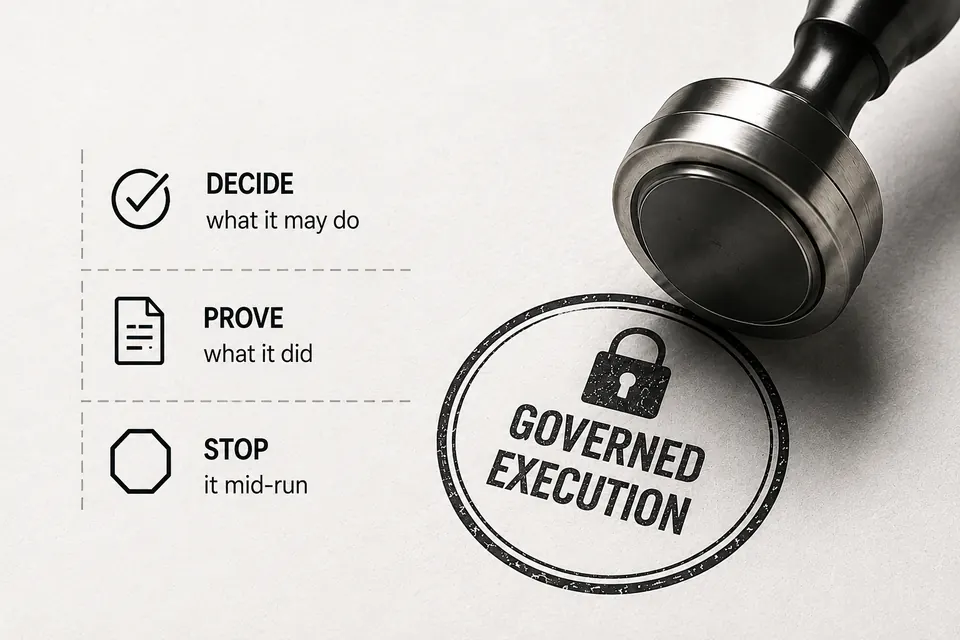
Multi-agent systems distribute responsibility across a network. Governed execution keeps authority, evidence, approvals, and accountability intact as work moves.

Key takeaways
- Multi-agent systems introduce coordination risk: individually plausible actions can combine into an unauthorized outcome.
- Delegation must carry explicit constraints, and effective authority must remain within the narrowest applicable scope.
- Durable agent identity makes ownership, least-privilege access, revocation, and attribution practical.
- Approval gates should follow impact and pause sensitive actions before they become real.
- Governance must reconstruct decisions across the whole workflow and preserve the ability to pause, redirect, and recover.
The future of enterprise AI depends less on how many agents we deploy—and more on how well we govern their work.
Multi-agent systems promise a significant change in how organizations operate. Instead of relying on one general-purpose AI assistant, a business could deploy specialized agents for research, finance, procurement, legal review, customer support, IT administration, and other operational functions. These agents could divide work, exchange information, use business applications, request help, and coordinate toward a shared goal.
The appeal is obvious. A complex request such as preparing a vendor renewal recommendation might involve one agent gathering contracts, another analyzing spending, a third assessing commercial risk, and a fourth producing an approval brief. Work that once moved slowly between departments could become faster, more consistent, and easier to scale.
But the central challenge in this future may not be intelligence.
It may be governance.
When multiple autonomous agents can plan, delegate, negotiate, access tools, and modify shared resources, responsibility becomes distributed. Accountability, however, cannot be. A business still needs to know who authorized the work, which policies applied, why a decision was made, and who owns the result.
That is where many conventional approaches to AI control begin to break down.
From model risk to coordination risk
Most organizations currently govern software through relatively stable structures. An application has defined users, permissions, owners, interfaces, and operating procedures. Even when the system is complicated, authority generally moves through recognizable paths.
Multi-agent systems behave differently.
An agent may receive a business objective, divide it into tasks, assign those tasks to other agents, use several tools, revise its plan as new information appears, and return a result that no single participant produced independently. Authority can move dynamically through the system as work progresses.
Consider a seemingly routine request:
Identify underperforming vendors, recommend which contracts should be renegotiated, and prepare the necessary communications.
A procurement agent may ask a finance agent to analyze spending. The finance agent may rely on a data-retrieval agent to collect invoices. A contract-review agent may identify unfavorable terms. A communications agent may then prepare—or potentially send—messages to vendors.
Each individual step can appear reasonable. Yet the combined workflow may produce an outcome that nobody explicitly approved.
Perhaps the spending data covered the wrong period. Perhaps the contract agent treated a missing clause as evidence of unfavorable terms. Perhaps the communications agent interpreted “prepare” as permission to send. No single action necessarily explains the failure. The risk emerged through the interaction between agents.
This is coordination risk: the possibility that individually plausible decisions combine into an incorrect, unsafe, or unauthorized system-level outcome.
Traditional monitoring often looks for a defective component. Multi-agent governance must also look for problematic relationships between components.

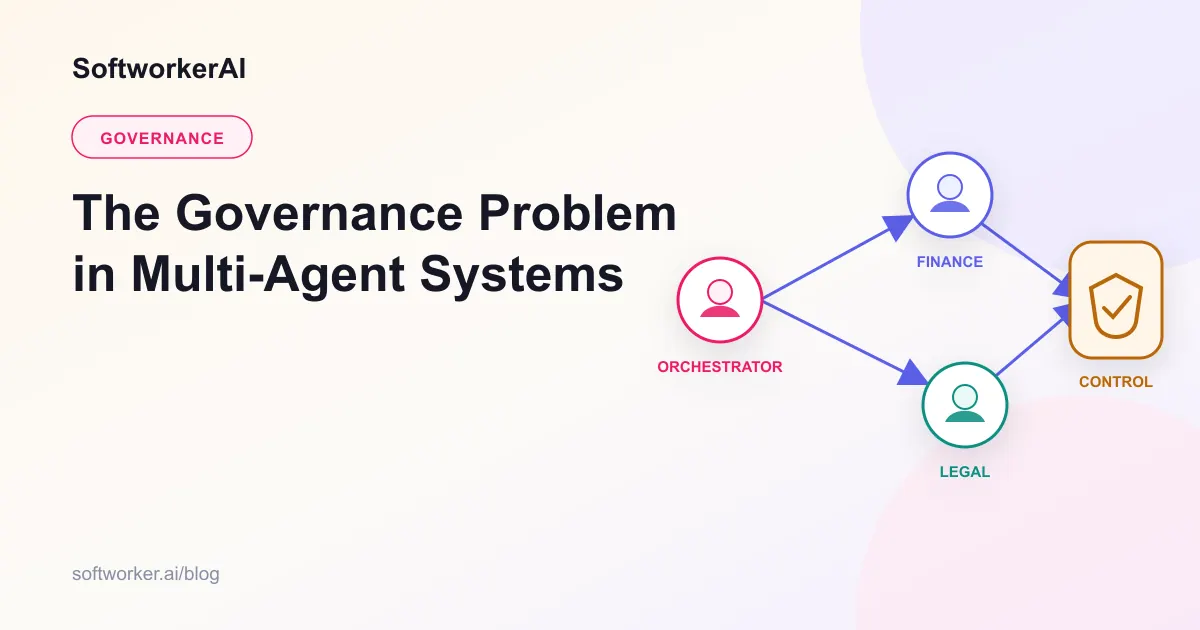
Coordination risk appears in the relationship between agents: no single step has to look obviously defective for the system-level outcome to cross the original authority.
Delegation must transfer constraints, not just tasks
Delegation is fundamental to multi-agent work, but it also creates one of its most important governance problems.
When a person delegates a task to an employee, the instruction carries implicit organizational context. The employee is expected to understand approval limits, confidentiality requirements, reporting lines, and professional responsibilities.
An AI agent cannot safely rely on those assumptions.
If one agent delegates work to another, the receiving agent needs more than an objective. It also needs the boundaries surrounding that objective:
- Which systems may it access?
- Which information may it use or disclose?
- Which actions may it take independently?
- Which decisions require approval?
- How much time or money may it spend?
- May it delegate further?
- What evidence must it return?
- When should it stop or escalate?
Without these constraints, delegation can silently expand authority.
An agent authorized to summarize contracts should not gain the ability to modify them merely because another agent asks. An agent allowed to draft a payment recommendation should not be able to initiate a transfer. An agent with access to one workstream should not inherit access to an entire workspace through a chain of delegated tasks.
In a governed system, authority should not become broader as it moves through the network. Every delegated task should carry an explicit scope, and every receiving agent should operate within the narrower intersection of its own permissions and the authority attached to the assignment.
This creates an important design rule:
Delegation may reduce authority, but it should never increase it without a new authorization.

Effective authority is the intersection of organizational role, assignment scope, and receiver permissions—not the union of everything the agent network can access.
Accountability requires identity
It is difficult to govern an actor that has no durable identity.
Yet many agent systems still treat agents as temporary prompt configurations rather than accountable participants in a business process. Their responsibilities may be described informally, their tool access may be shared, and their activity may appear in logs without a clear owner.
That model does not scale.
Every production agent should have an identifiable role, a defined purpose, an accountable human or team, and a clearly bounded set of capabilities. The organization should be able to answer:
- What is this agent responsible for?
- Who created or approved it?
- Who owns its instructions and policies?
- Which tools and data sources can it access?
- Which other agents can assign work to it?
- Which decisions can it make independently?
- Who reviews its performance?
- How can its access be revoked?
Identity turns an agent from an opaque technical process into a governable organizational actor.
It also makes least-privilege access practical. Credentials can be scoped to the agent’s role rather than shared across an entire agent network. Permissions can be reviewed, changed, or revoked without disabling unrelated workflows. Actions can be attributed to the agent that performed them and the person or policy that authorized them.
SoftworkerAI describes this as part of governed autonomy: every agent operates with identity, scoped access, approval gates, supervision, policy, and audit built into the way work is executed. These controls are not an administrative layer added after the agent has acted. They are part of the execution environment itself.
Approval should follow impact
Human oversight is necessary, but requiring a person to approve every agent action defeats much of the value of automation. The goal is not constant intervention. It is proportionate control.
Low-risk, reversible actions may be allowed to proceed automatically. An agent might gather approved records, compare information, classify documents, or prepare a draft without waiting for permission at each step.
Higher-impact actions require stronger controls. These may include:
- Sending external communications
- Modifying authoritative records
- Moving money
- Accepting contractual terms
- Granting or revoking access
- Disclosing sensitive information
- Deleting data
- Making decisions that materially affect a customer, employee, or supplier
These actions may require human approval, independent verification by another agent, additional evidence, or a stricter policy check.
The important point is that approval gates must exist inside the workflow. A policy document telling employees to “review important AI decisions” is not enough if the agent can complete the action before the review happens.
A governed workspace should pause execution at the moment authority is required. The reviewer should see what the agent intends to do, the evidence it used, the applicable policy, and the expected consequences. The person can then approve, reject, or redirect the work before the action becomes real.
In SoftworkerAI, this distinction separates an agent that merely acts from one that acts within governed boundaries: sensitive or irreversible steps stop at approval gates, while permitted work continues without unnecessary friction.
Audit trails must reconstruct decisions, not merely list events
A conventional application log may show that an API was called or a record was changed. That is useful, but it is insufficient for agentic work.
To understand an agent’s behavior, an organization may need to reconstruct the full chain:
- What goal did the human delegate?
- How did the system interpret it?
- Which plan was proposed?
- Which agent received each responsibility?
- What evidence did each agent collect?
- Which policies and permissions applied?
- What assumptions were made?
- Which approvals were requested and granted?
- What tool calls or external actions occurred?
- What outcome was produced?
This is not logging for logging’s sake. It is the evidence required to investigate mistakes, resolve disputes, improve performance, demonstrate compliance, and decide whether an agent should receive greater autonomy.
It is also essential when agents disagree.
Suppose one agent recommends renewing a supplier because of its operational performance while another recommends termination because of contract risk. Governance should not hide that disagreement inside a final synthesized answer. The system should preserve both assessments, show the supporting evidence, identify the policy used to resolve the conflict, and record who accepted the resulting decision.
An audit trail should make responsibility more legible as work becomes more complex—not bury it beneath a larger volume of machine-generated activity.
Governing the network, not only the individual agent
An agent can follow its instructions and still contribute to a harmful collective outcome.
Several agents may repeat the same work, escalating cost without improving the answer. Two agents may act on inconsistent versions of the same data. Agents may reinforce one another’s false assumptions. A planning agent may divide a task in a way that omits an important review. A group may optimize for speed or completion rate while quietly reducing quality.
This means agent governance cannot be limited to evaluating each participant separately.
The system must also monitor the network:
- Are agents working from consistent goals and evidence?
- Are responsibilities duplicated or missing?
- Are delegations creating circular workflows?
- Are agents repeatedly validating one another without independent evidence?
- Are costs increasing because tasks are being unnecessarily re-planned?
- Are approval gates being avoided through task decomposition?
- Is the network satisfying a measurable target while undermining the real business objective?
These are emergent behaviors. They exist at the level of the workflow rather than the individual model.

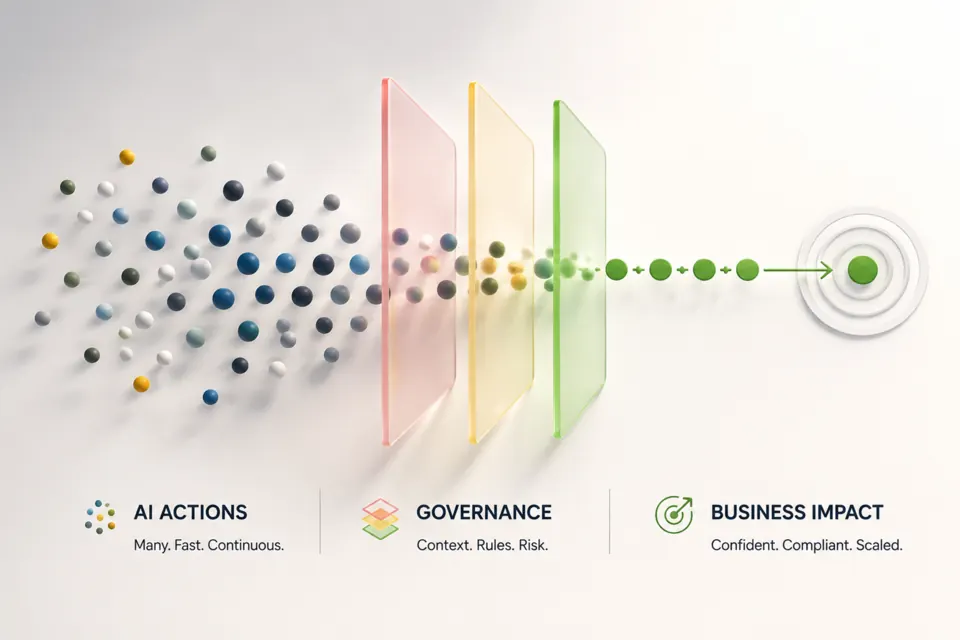
A shared execution layer preserves accountability as responsibility moves between agents and people.
SoftworkerAI’s multiplayer workspace approach is relevant here because people and agents work within the same shared threads, tasks, plans, and approvals. Governance and collaboration occur on the same surface, allowing the organization to inspect not only what one agent did but how the entire piece of work moved from request to outcome.
Governance also means the ability to regain control
A system is not governed merely because it behaves correctly under normal conditions. It must remain controllable when something goes wrong.
Organizations need the ability to:
- Pause a running workflow
- Cancel a plan before completion
- Revoke an agent’s credentials
- Isolate an agent or integration
- Prevent further delegation
- Redirect unfinished work
- Resolve conflicts between agents
- Retry a failed step safely
- Recover from partial completion
- Preserve evidence for investigation
This requires workflows to be designed for partial failure.
If one agent fails, the system should not necessarily lose the work completed by every other participant. If an approval is rejected, the workflow should return to an appropriate decision point rather than restarting blindly. If an integration is compromised, its access should be removable without bringing down the entire operating environment.
The ability to interrupt, inspect, and recover is not an edge-case feature. It is part of the basic contract between autonomous systems and the organizations that operate them.
Governance should be operational, not ceremonial
Many organizations already have AI principles, acceptable-use policies, risk committees, and review processes. These remain valuable, but multi-agent systems require those policies to become executable.
A rule such as “financial commitments above a defined threshold require approval” should become a runtime control. A restriction on sensitive data should shape which knowledge sources an agent can access. A requirement for independent review should determine how work is routed. A model policy should decide which approved model can handle a particular class of information or task.
In other words, governance must move from documents into workflows.
This is central to the SoftworkerAI model: a business user delegates a goal, the system routes the work to appropriate agents and skills, policy checks remain visible, sensitive actions pause for approval, and evidence is captured throughout execution. SoftworkerAI positions itself as a core platform for building, orchestrating, governing, and operating AI agents inside a shared workspace—not simply as another chatbot interface.
That distinction matters because enterprise trust will not come from an agent claiming that it followed policy. It will come from the system being able to demonstrate that the policy constrained what the agent could do.
Autonomy should be earned
Organizations do not have to choose between manual work and unrestricted autonomy.
A safer approach is progressive delegation.
Begin with one valuable, rule-bound workflow. Give the agent access only to the systems it needs. Require approval for sensitive actions. Observe its decisions and outcomes. Measure accuracy, rework, cycle time, cost, and business impact. Expand the agent’s scope only when the evidence supports doing so.
Under this model, autonomy is not a one-time configuration. It is an earned operating privilege.
A workflow may initially run in observation mode. It may then be allowed to prepare recommendations, followed by drafts, followed by low-risk execution. Higher-impact actions may always remain subject to human judgment.
This approach preserves the productivity benefits of agents without treating trust as an assumption.
The four questions every multi-agent system must answer
As agent networks become more capable, governance will determine whether they remain controlled instruments of organizational intent or become opaque chains of delegated decisions that nobody can fully explain.
The organizations that succeed will not necessarily deploy the largest number of agents. They will be the ones that can answer four questions at every moment:
- Who authorized this action?
- What limits applied to it?
- What evidence supported it?
- Who is accountable for the result?
These questions should be answerable for the work of one agent, for a delegation between agents, and for the final outcome produced by the network.
The principle behind them is simple:
Autonomy should never exceed accountability.
SoftworkerAI is being built around that principle: a multiplayer workspace where humans and governed AI agents can plan, approve, and complete real work together, with identity, scoped access, approval rules, supervision, policy, audit, and measurable impact built into the operating model.
In the multi-agent era, governance is not merely a compliance function. It is infrastructure. It is product architecture. And it is the prerequisite for turning increasingly capable AI agents into trusted participants in real organizational work.